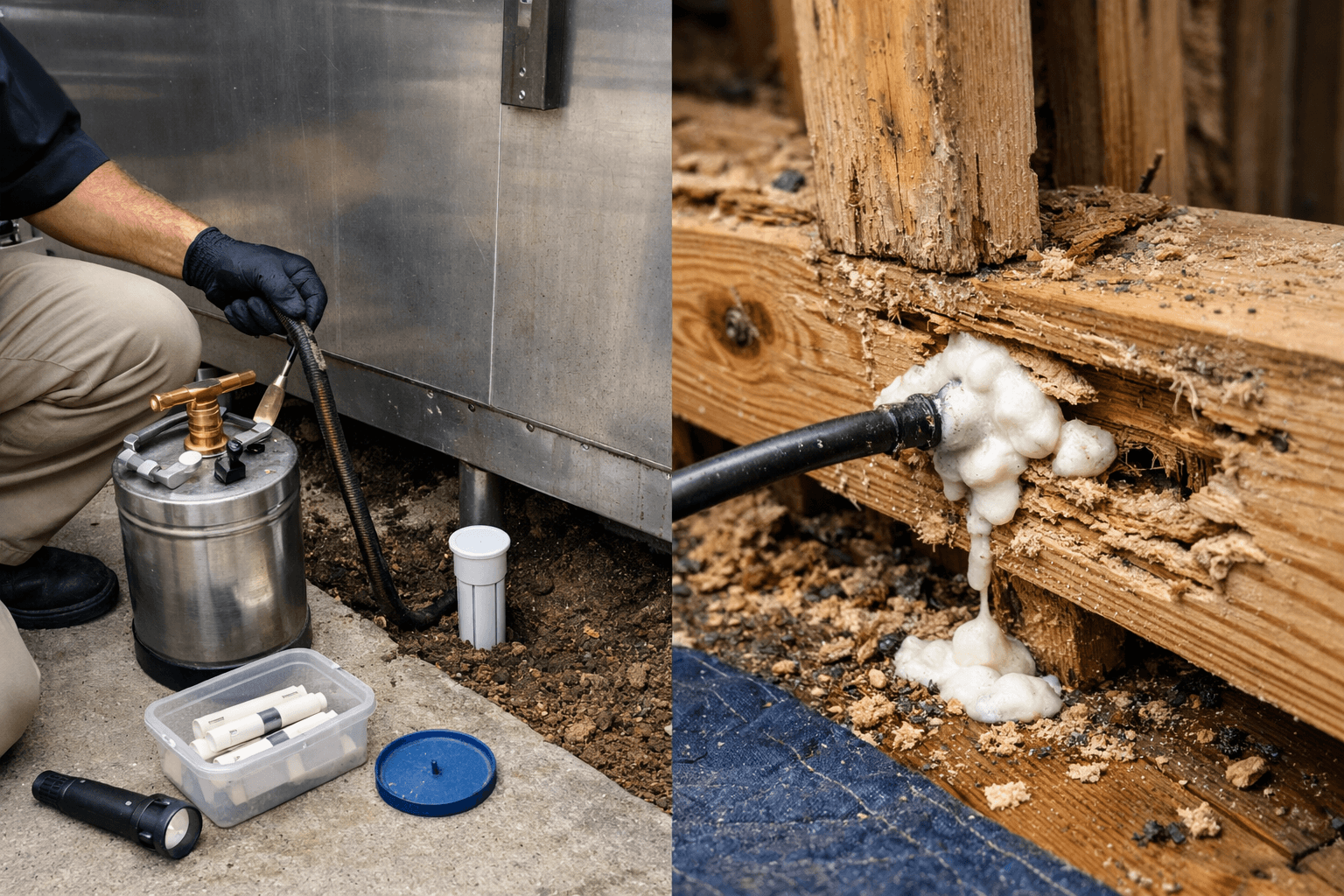
Learn what professional pest control involves for Atlantic County restaurants, from inspections and treatment to compliance requirements and prevention strategies.
What does restaurant pest control in Atlantic County actually involve?
Restaurant pest control in Atlantic County means a licensed technician inspects your kitchen, storage areas, and exterior, identifies current or likely pest pressure, then sets up a treatment and monitoring program tailored to a food service environment. The goal is elimination and prevention — using methods that are safe around food prep surfaces and keep you compliant with New Jersey Department of Health regulations.
Will a pest control visit shut down my restaurant or disrupt service?
A professional commercial pest control visit almost never requires you to close. Technicians schedule exterior treatments, bait station checks, and interior monitoring during off-hours or low-traffic windows. Treatments applied inside a food service facility use products and placement methods that meet NJ food code requirements, so you stay open and stay compliant.
How often does a restaurant in Atlantic County need pest control service?
Most food service operators in Atlantic County need monthly service at minimum, with many high-volume kitchens scheduling bi-weekly visits. Atlantic County's coastal humidity, warm summers, and proximity to wetlands in areas like Egg Harbor, Galloway, and Atlantic City create year-round pest pressure — roaches, rodents, flies, and stored-product pests don't take a season off.
Below, we'll walk through exactly what a professional pest control program looks like for Atlantic County restaurants — from the first inspection to ongoing compliance documentation — and what to look for in a provider who understands the food service environment.
If you're operating a restaurant in Atlantic County without a documented pest control program, that's the kind of thing a health inspector notices first. A single complaint or failed inspection can mean a temporary closure, and in a coastal tourism market, word travels fast.
Quick Checklist: What Your Restaurant Pest Program Should Include
- Written inspection report from every visit — dated and signed
- Pest identification and activity mapping for your specific facility
- Bait station placement diagram (required for many NJ health inspections)
- Interior and exterior treatment using food-safe, labeled products
- Documentation file you can hand to a health inspector on the spot
- Emergency or same-day response when something shows up unexpectedly
- A single point of contact who knows your building
If your current provider isn't giving you all of that, it's worth a second look. A free inspection with no commitment is a reasonable starting point — you'll know within an hour where you stand.
Why Atlantic County restaurants face higher pest pressure than most
Atlantic County's geography creates conditions that pest professionals deal with constantly. The coastal wetlands around Atlantic City and Brigantine drive mosquito and fly pressure. Sandy, moist soil throughout Egg Harbor, Galloway, and Hammonton is prime habitat for subterranean termites. And older commercial buildings in places like Absecon and Buena hold the gaps, aging plumbing, and food residue buildup that rodents and cockroaches look for.
Add high foot traffic, delivery door activity, floor drains, and grease traps — all normal parts of a working kitchen — and you have a pest environment that demands a structured program, not a one-time spray.
According to the New Jersey Department of Health Food Safety Program, pest control documentation is a core part of food establishment inspections. Failing this section can result in critical violations, point deductions, or closure orders.
What is Integrated Pest Management, and why does it matter for food service?
Integrated Pest Management (IPM) is the standard approach for any food service pest program worth having. Instead of spraying on a calendar and calling it done, IPM uses inspection data to find out why pests are present, then combines targeted treatments, physical exclusion, and sanitation recommendations to eliminate the source — not just the symptom.
For a restaurant in Atlantic County, that means your technician isn't just treating the perimeter. They're checking floor drains, behind cooking equipment, inside dry storage, along wall voids, and at every door and utility penetration. They're looking for entry points, moisture sources, and harborage areas — and documenting everything.
This approach matters for two reasons. First, it works better and lasts longer than broadcast chemical treatment. Second, it produces the paper trail that protects you during a health inspection. The EPA's IPM guidance confirms that this method consistently outperforms reactive, spray-only programs in sensitive environments like kitchens and food storage areas.
IPM vs. Conventional Pest Control for Restaurants
| Factor | IPM Approach (Recommended) | Spray-Only / Reactive |
|---|---|---|
| Treatment basis | Inspection data, source elimination | Calendar schedule, broadcast spray |
| Documentation | Written report every visit | Minimal or none |
| Health inspection ready | Yes — paper trail on hand | Often not |
| Long-term results | Sustained, measurable control | Temporary — pests return |
| Chemical exposure | Targeted, food-safe placement | Higher, less controlled |
- Treatment basis: IPM uses inspection findings — vs. spray-only runs on a fixed calendar regardless of activity
- Documentation: IPM generates a written report each visit — vs. reactive service that often leaves nothing in writing
- Health inspection ready: IPM produces a paper trail you can hand over immediately — vs. spray-only programs that leave you scrambling
- Long-term results: IPM eliminates sources for sustained control — vs. broadcast spray that lets pests return between visits
- Chemical exposure: IPM uses targeted, food-safe placement — vs. higher, less controlled chemical use throughout the facility
What to expect from the first visit
A commercial pest inspection for a food service facility in Atlantic County starts outside. The technician walks the building perimeter, checks foundation gaps, door sweeps, utility entry points, dumpster placement, and grease trap access. Then they move inside — kitchen, prep areas, dry storage, break room, bathrooms, and any mechanical rooms or crawl spaces.
You'll get a written report that identifies what's present, what's at risk, and exactly what treatment and monitoring program is recommended. No guessing, no verbal-only quotes. A-Altair puts every estimate in writing before any work begins — so you know exactly what you're agreeing to.
For restaurants near the coast in Brigantine, Absecon, or along the shore corridor, the inspection will pay particular attention to moisture entry points and rodent exclusion — both of which are elevated concerns in that environment. For inland locations in Galloway, Hammonton, or Buena, termite pressure and stored-product pest management get more focus.
How discretion works in a commercial setting
Nobody wants a pest control truck parked out front during the lunch rush. A professional commercial provider works around your schedule — early morning before staff arrives, late evening after close, or during your slowest service window. Treatments are applied in a way that leaves no visible residue and no odor that carries into the dining room.
This matters especially in Atlantic County's hospitality market. From the casino corridor in Atlantic City to family restaurants throughout Egg Harbor and Galloway, your reputation is built one meal at a time. A pest sighting — even a single one in the dining room — can end up online within the hour. A solid prevention program keeps that from ever becoming a conversation.
If you have questions about what's common in Atlantic County and what's been overstated, the Atlantic County Pest Control Myths post breaks down what's real and what's noise when it comes to local pest pressure.
A-Altair has been serving South Jersey food service operators for over 20 years. NJ state licensed, fully insured, and backed by a 100% satisfaction guarantee — if pests return between scheduled treatments, we come back at no charge. There are no travel surcharges in Atlantic County communities, and same-day response is available when you need it. For Pest Control across Atlantic County, the number to call is (609) 561-6649 (Hammonton line) or reach us at (856) 768-9263.
Frequently Asked Questions
Does my restaurant in Atlantic County legally need a pest control program?
New Jersey food establishment regulations require that restaurants maintain facilities free of pests and demonstrate active pest management. While there's no statute mandating a specific contract, NJ Department of Health inspectors assess pest control documentation as part of routine inspections. Operating without a documented program creates a real compliance risk, including critical violations that can lead to temporary closure orders.
What pests are most common in Atlantic County restaurants?
German cockroaches are the most frequently cited pest in Atlantic County food service complaints — they thrive in warm, humid kitchen environments. Rodents (mice and rats) are common in older commercial structures near the shore corridor. Flies, drain flies, and stored-product pests like Indian meal moths are also common, especially in high-volume kitchens with active deliveries and floor drains.
How quickly can A-Altair respond to a pest emergency at my restaurant?
A-Altair offers same-day and emergency call-outs for commercial accounts across Atlantic County, including Atlantic City, Egg Harbor, Hammonton, and Galloway. If you discover an active pest problem before a health inspection, a service call, or a busy weekend, call (609) 561-6649 or (856) 768-9263. We'll get a licensed technician to you the same day whenever possible.
Will I need to close the restaurant during treatment?
In most cases, no. Commercial pest treatments in food service environments use targeted application methods — bait stations, crack-and-crevice treatments, and exterior barrier applications — that don't require facility closure. Technicians schedule interior work during off-hours to avoid any disruption to your operation. If a specific situation ever did require a brief vacancy period, you'd be told upfront in writing before any work began.
What documentation will I have for health inspections after service?
After every visit, you receive a written service report documenting what was inspected, what pest activity was found, what treatments were applied, and where bait stations or monitoring devices are placed. Over time, this builds a service history file you can present to an NJ Department of Health inspector immediately. That paper trail is one of the most practical protections a food service operator can have.
Ready to get your Atlantic County restaurant on a compliant, documented pest control program? Schedule a free inspection — no commitment, no obligation. A-Altair's licensed technicians will walk your facility, give you a written assessment, and tell you exactly what's needed. Call (609) 561-6649 (Hammonton) or (856) 768-9263 Monday through Friday, 8 a.m. to 5 p.m. Emergency call-outs are available when you need us outside those hours.
A-Altair Termite and Pest Control, Inc.
Licensed pest control professionals serving Camden, Burlington, Gloucester, and Atlantic counties, NJ.
(856) 768-9263