Compare heat and chemical bed bug treatments in South Jersey. Learn how each works, treatment timelines, costs, and which option is best for your infestation.
What is the best bed bug treatment — heat or chemicals?
Heat treatment kills bed bugs at all life stages in a single visit by raising room temperatures to 120–135°F, which bed bugs cannot survive. Chemical treatment uses EPA-registered insecticides applied in multiple visits and works well for targeted or preventive follow-up. The best approach depends on the size of the infestation, your home's layout, and how fast you need results.
How long does bed bug treatment take to work?
Heat treatment works in one day — technicians heat the space, bugs die within hours, and you can return to the room the same evening. Chemical treatment takes longer: most programs run two to three visits spaced two weeks apart, with full results in three to four weeks. Eggs that hatch after the first chemical application are addressed in follow-up treatments.
Can bed bugs come back after professional treatment?
Bed bugs can return if new ones are brought in on luggage, furniture, or clothing after treatment — not because the original treatment failed. Re-infestation from outside is the most common reason bugs reappear. A licensed technician will walk you through prevention steps after treatment, and A-Altair's 100% satisfaction guarantee means we retreat for free if pests return between scheduled visits.
If you've spotted bed bugs — or even just suspicious bites — in your Cherry Hill home, a Mount Laurel rental, or a hotel property in Atlantic City, here's everything you need to know to make a confident decision. We'll break down how each method works, where each one wins, and how to choose the right fit for your situation.
Why Bed Bug Problems Hit South Jersey Hard
Bed bugs don't care how clean your home is. They hitchhike on luggage, secondhand furniture, and clothing, and South Jersey's mix of dense neighborhoods, shore rentals, college towns, and older housing stock gives them plenty of opportunities to spread.
Communities like Camden, Voorhees, Deptford, and Egg Harbor Township all see bed bug calls. Vacation properties near the shore get hit hard in summer. Older row homes in Camden and Gloucester City have tight spaces that let infestations spread between units before anyone notices. The faster you act, the smaller the problem stays.
If you ignore bed bugs, the infestation doubles roughly every six weeks. One pregnant female can seed an entire bedroom. By the time bites are obvious, hundreds of bugs may already be living in your mattress seams, box spring, and baseboards.
Quick Check: Signs You Have Bed Bugs
- Small rust-colored stains on sheets or mattress seams (crushed bugs or fecal spots)
- Tiny white eggs or shed skins in mattress seams, behind headboards, or in outlet covers
- Itchy, welted bites in lines or clusters on exposed skin
- A faint sweet, musty odor in heavily infested rooms
- Live bugs — flat, apple-seed-sized, reddish-brown — active at night
Spot any of these? Schedule a free inspection right away. A-Altair offers no-commitment inspections across all of Camden, Burlington, Gloucester, and Atlantic counties — same-day availability when you call early.
How Does Heat Treatment Work?
Heat treatment is exactly what it sounds like. Technicians bring industrial electric heaters into the affected space and raise the air temperature to between 120°F and 135°F, holding it there long enough to penetrate furniture, mattresses, wall voids, and every other hiding spot bed bugs use. According to the EPA, bed bugs die when exposed to temperatures above 120°F — and heat reaches every crack a spray wand cannot.
The big advantages of heat:
- One-day treatment. Most residential rooms are done in six to eight hours. You return home the same day.
- No life stage survives. Eggs, nymphs, and adults all die. Chemical treatments struggle with eggs.
- No chemical residue. Safe for homes with young children, pets, or people with sensitivities.
- No bagging or laundering required. You don't have to box up every item in the room before treatment.
Heat does have limits. Electronics and certain heat-sensitive items (wax candles, aerosols, vinyl records) need to be removed before treatment. It also doesn't leave a residual barrier, so if a bug walks back in from an adjacent unit the next week, there's nothing to stop it.
How Does Chemical Treatment Work?
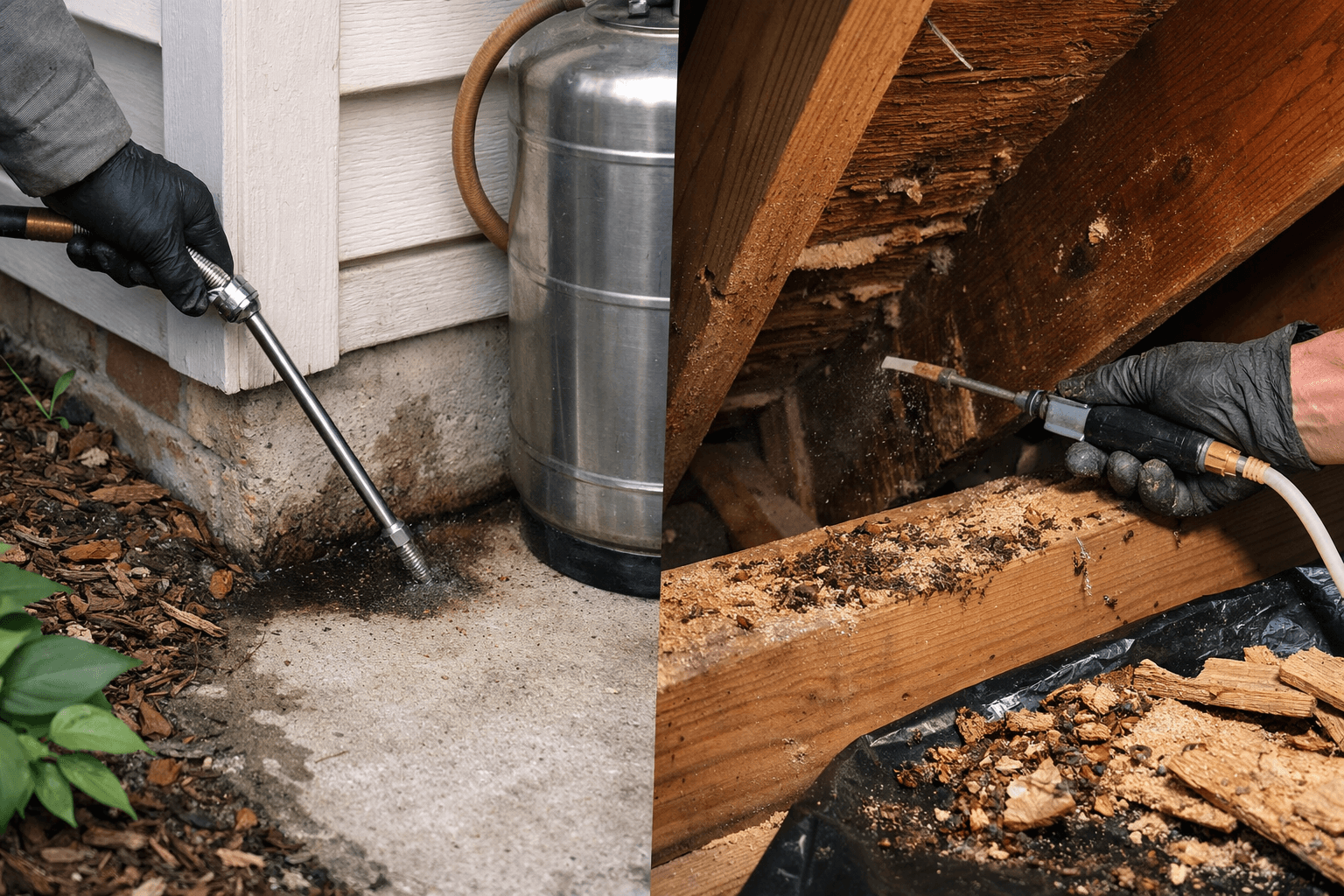
Chemical bed bug treatment uses EPA-registered insecticides — typically a combination of contact killers, residual sprays, and dusts — applied to the specific areas where bed bugs live and travel. A licensed technician targets mattress seams, box springs, baseboards, electrical outlets, and furniture joints. Follow-up visits address any eggs that hatch after the first application.
Where chemical treatment shines:
- Residual protection. Treated surfaces keep killing bugs that walk across them for weeks after application.
- Targeted follow-up. Great for low-level infestations or as a follow-up after heat to protect against re-entry.
- Works in hard-to-heat spaces. Older homes with thick plaster walls, tight crawl spaces, or large multi-room layouts sometimes have spots that are difficult to bring up to heat uniformly.
- Lower disruption to belongings. No need to remove electronics or heat-sensitive items.
The downside is time. Multiple visits are part of the plan, and you'll need to stay out of treated rooms for a few hours after each application. Results aren't instant — they build over two to four weeks as bugs contact treated surfaces and as follow-up visits address newly hatched eggs.
Heat vs. Chemical Treatment: Which One Is Right for You?
- Speed: Heat finishes in one visit — vs. chemical, which takes 2–3 visits over 3–4 weeks.
- Eggs: Heat kills all eggs immediately — vs. chemical, which relies on follow-ups to catch newly hatched nymphs.
- Residual barrier: Chemical leaves weeks of residual protection — vs. heat, which leaves none after treatment.
- Chemical sensitivity: Heat is chemical-free — vs. chemical, which requires brief room vacating after each treatment.
- Best for large infestations: Heat — vs. chemical, which is better for light or early-stage infestations.
- Best for re-infestation risk: Chemical (residual barrier) — vs. heat alone, which doesn't protect against re-entry.
Heat vs. Chemical Bed Bug Treatment at a Glance
| Factor | Heat Treatment | Chemical Treatment |
|---|---|---|
| Number of visits | 1 (same day) | 2–3 over 3–4 weeks |
| Kills eggs | Yes — immediately | Indirectly, via follow-up visits |
| Residual protection | None after treatment | Weeks of residual barrier |
| Chemical exposure | Zero | Low — brief vacating required |
| Prep work required | Remove heat-sensitive items | Minimal |
| Best for | Heavy infestations, fast resolution | Light infestations, residual defense |
Many of our most effective treatments combine both methods — heat to eliminate the existing population all at once, chemical residual applied afterward to catch any bugs that re-enter from a neighboring unit. This hybrid approach is especially useful in Gloucester County townhomes, Burlington County apartment communities, and Atlantic County shore rentals where adjacent units can be a source of re-infestation.
What South Jersey Homeowners and Landlords Should Know Before Choosing
If you own a single-family home in Marlton or Medford and you caught the problem early, chemical treatment handled across two visits is often a clean, straightforward solution. If you're dealing with a whole-bedroom infestation in a Cherry Hill rental or a beachside property in Galloway and you need it resolved in a day, heat is the right call.
Landlords managing multi-unit buildings in Camden or Washington Township need to think about re-infestation risk from adjacent units. In those cases, chemical residuals applied in hallways, common areas, and along baseboards give ongoing protection that heat alone cannot provide.
Our Bed Bug Treatment service covers the full Camden County area, including communities like Audubon and Audubon Park. We also handle Bed Bug Treatment across Burlington County, reaching communities from Southampton all the way into Medford and Mount Laurel. And in Gloucester County, our Bed Bug Treatment team serves South Harrison and surrounding townships.
Before any treatment begins, you get a written estimate. The number we quote is the number you pay — no travel surcharges, no surprise fees. The CDC recommends professional pest control as the most reliable method for eliminating bed bug infestations, and with over 20 years serving South Jersey, our NJ state licensed, fully insured technicians know every local housing type from Hammonton bungalows to Deptford townhomes.
Frequently Asked Questions
Do I have to throw away my mattress after bed bug treatment?
No — in most cases you do not need to discard your mattress. Both heat and chemical treatments are designed to eliminate bed bugs living in and around the mattress without destroying it. After treatment, a mattress encasement is recommended to protect against re-infestation. Your technician will advise you based on the condition of the mattress after inspection.
How should I prepare my home before a bed bug heat treatment?
Before heat treatment, remove heat-sensitive items from the treatment area: aerosol cans, wax candles, certain medications, vinyl records, and electronics that cannot tolerate high temperatures. You do not need to bag or launder all clothing before heat treatment — that prep is typically associated with chemical treatments. Your technician will give you a specific prep checklist during the free inspection visit.
Are bed bug treatments safe for children and pets?
Heat treatment is entirely chemical-free, making it a strong option for households with young children or pets. For chemical treatments, NJ state licensed technicians use EPA-registered products applied to targeted surfaces. Children and pets are asked to vacate treated rooms for a few hours after application. Once surfaces are dry, the space is safe for normal use. Your technician will confirm re-entry timing before leaving.
How do I know if the bed bug treatment worked?
After a successful treatment, bite activity should stop within one to two weeks. For heat treatment, dead bugs may be visible immediately. For chemical treatment, bugs that contact treated surfaces will die over the following days and weeks. If live bugs or new bites appear after a completed treatment program, A-Altair's 100% satisfaction guarantee covers a free retreat — no arguments, no extra charge.
Do you treat commercial properties for bed bugs in South Jersey?
Yes. A-Altair treats hotels, motels, multi-unit residential buildings, shelters, and other commercial properties throughout Camden, Burlington, Gloucester, and Atlantic counties. Commercial bed bug programs can include both heat and chemical options, with Integrated Pest Management documentation available for property managers. Call us for a free commercial inspection — same-day availability for urgent situations.
Bed bugs are stressful, but they're fixable with the right approach. Whether heat treatment, chemical treatment, or a combination of both is the right fit for your situation, A-Altair's licensed technicians will tell you exactly what they recommend — in writing, before any work begins. Call us today to schedule your free, no-commitment inspection: (856) 768-9263 (main line), Cherry Hill 856-424-5646, Sewell 856-728-2101, or Hammonton 609-561-6649. We're available Monday through Friday, 8 a.m. to 5 p.m., with emergency call-outs when you need us sooner.
A-Altair Termite and Pest Control, Inc.
Licensed pest control professionals serving Camden, Burlington, Gloucester, and Atlantic counties, NJ.
(856) 768-9263