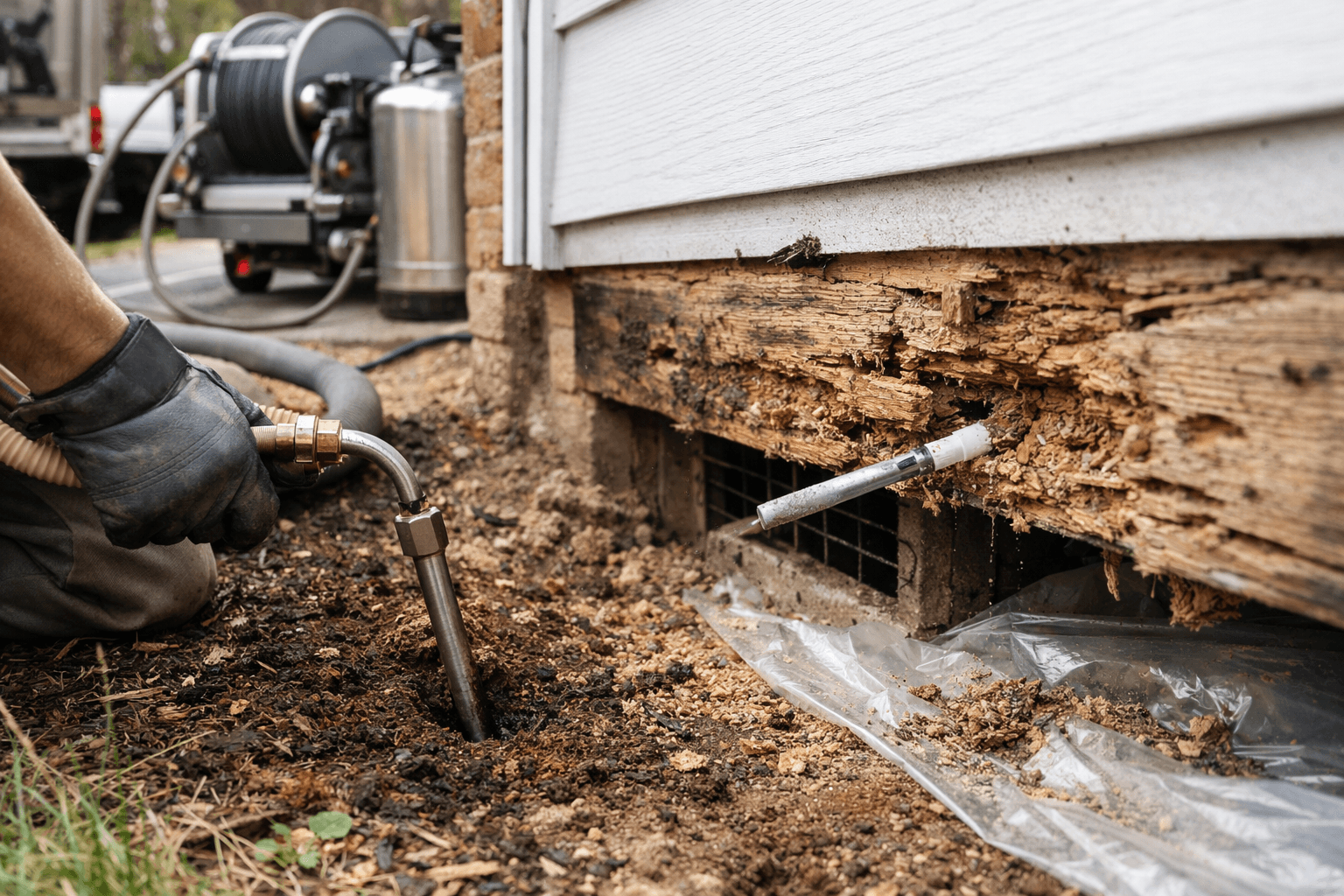
Learn what termite activity looks like in fall, how to identify an infestation, and what treatment options work best for Cherry Hill homeowners.
Do termites stay active in the fall in Cherry Hill, NJ?
Yes — termites in South Jersey remain active well into fall and even through mild winters. Subterranean termite colonies don't die off when temperatures drop; they burrow deeper into the soil and continue feeding on the wood in your home's foundation and framing. By the time you see visible damage, a colony may have been feeding for a year or more.
How do I know if I have termites and not just wood rot or carpenter ants?
The fastest way to know for certain is a professional inspection — but there are signs to watch for. Termites leave mud tubes along foundation walls, hollow-sounding wood, discarded wings near windowsills, and frass (tiny wood pellets from drywood termites). Wood rot looks soft and spongy; carpenter ant damage shows clean galleries. A licensed technician can tell you which one you're dealing with in about 30 minutes.
What does termite treatment in Cherry Hill, NJ actually involve?
Treatment depends on the termite species. Subterranean termites — the most common in Camden County — are treated with liquid soil treatments or bait station systems placed around your home's perimeter. Drywood termites require either localized wood treatments or whole-structure fumigation in severe cases. A thorough inspection comes first, followed by a written estimate before any work begins.
If you've been wondering what's going on behind your drywall or under your crawl space this season, you're not alone. Fall is when a lot of Cherry Hill homeowners start noticing the signs they'd missed all summer — and it's also the right time to act. This guide covers what termite activity looks like in our area this time of year, how treatment works, and what to do next.
Why Fall Is Still Termite Season in Cherry Hill
Most people picture termite swarms in the spring and assume the threat fades once the weather cools. That's not how it works in South Jersey. Subterranean termites — the species responsible for the vast majority of structural damage in Camden County — live in underground colonies that can number in the hundreds of thousands. They don't hibernate. When surface temperatures drop, they follow the warmth deeper into the soil and straight toward the heated wood structure sitting above them: your home.
The sandy, loamy soil throughout Cherry Hill and surrounding Camden County communities is particularly favorable for subterranean termite colonies. It drains quickly, stays loose, and makes tunneling easy. That's not bad luck — it's just the local geology, and it's why termite pressure in this area is among the highest in New Jersey.
Fall is also when homeowners seal up their houses for winter — closing up crawl spaces, finishing basements, and caulking windows. That work can trap an existing termite problem inside and give it nowhere to go but further into your structure.
What Does Active Termite Damage Look Like?
Termites are quiet. That's part of why they cause so much damage — they work inside wood, not on the surface. But there are reliable warning signs, especially heading into fall:
- Mud tubes running along your foundation walls, piers, or floor joists — these are the highways subterranean termites use to travel between soil and wood
- Hollow-sounding wood when you knock on baseboards, door frames, or structural beams
- Doors or windows that suddenly stick — termite damage can warp wood framing enough to affect how things open and close
- Discarded wings near windowsills or on spider webs — a sign that swarmers passed through earlier in the year
- Bubbling or peeling paint on walls that look like water damage but aren't near any plumbing
- Frass (small, pellet-shaped droppings) near wood surfaces — a sign of drywood termites specifically
Finding one of these signs doesn't guarantee a full-blown infestation, but it means an inspection is the right next move. Finding several means you shouldn't wait.
Subterranean vs. Drywood Termites: What Cherry Hill Homeowners Face
- Species: Subterranean termites vs. drywood termites
- Where they live: Underground colonies connected by mud tubes vs. inside dry wood — no soil contact needed
- Damage pattern: Follows wood grain, hollows beams from inside vs. creates isolated pockets across grain
- Signs: Mud tubes on foundation, hollow wood, stuck doors vs. frass pellets, surface blistering on wood
- Treatment: Soil treatment or bait stations vs. localized wood treatment or fumigation
- Most common in South Jersey: Subterranean — by a wide margin
| Factor | Subterranean (Most Common Here) | Drywood |
|---|---|---|
| Colony size | Hundreds of thousands | Smaller, a few thousand |
| Damage speed | Fast — large colony, constant feeding | Slower, but still structural |
| Treatment approach | Soil barrier or bait system | Wood treatment or fumigation |
| Winter activity | Active — goes deeper, keeps feeding | Slows in cold, still present |
How Termite Treatment Works — No Guesswork, No Surprises
At A-Altair Termite and Pest Control, the process starts with a free inspection — no commitment, no pressure. A licensed NJ technician walks your property, checks crawl spaces, examines the foundation, looks at wood framing, and identifies exactly what you're dealing with. If there's nothing there, you'll know. If there is a problem, you'll get a written estimate before any treatment begins.
For subterranean termites, treatment typically involves creating a chemical barrier in the soil around your home's perimeter or installing a bait station system that worker termites carry back to the colony. Both methods eliminate active colonies and protect against new ones. For drywood termites, the approach is more localized — treating affected wood directly or, in severe cases, treating the whole structure.
Because we handle everything in-house — from the initial Termite Control inspection through treatment and Cherry Hill termite repair work — there's one accountable team on your job from start to finish. No subcontractors, no handoffs.
According to the U.S. Environmental Protection Agency, termites cause an estimated $5 billion in property damage in the United States each year — most of it not covered by standard homeowners insurance. The Entomological Society of America notes that subterranean termites are the most destructive wood-destroying insects in North America. That's not meant to alarm you — it's meant to explain why a free inspection is worth 30 minutes of your time.
Fall Termite Action Checklist for Cherry Hill Homeowners
- Walk your foundation and look for mud tubes — especially after rain when soil is disturbed
- Check your crawl space or basement for hollow-sounding joists and any visible tunnel structures
- Look around window and door frames for wood that feels soft, bends, or has started sticking
- Clear wood debris, mulch, and firewood stacked against your foundation — these are termite magnets
- Fix any moisture issues: leaky gutters, standing water near the foundation, condensation in crawl spaces
- Schedule a free inspection before you seal up the house for winter — don't lock a problem inside
Already seeing something that looks off? Don't wait. Same-day and emergency call-outs are available — just call the Cherry Hill line at 856-424-5646. Our technicians are in this community, not hours away.
Beyond termites, fall is also when rodents start looking for warm entry points and when indoor pest pressure picks up. A-Altair handles all of it — from Pest Control maintenance plans to Rodent Control exclusion work — so you're not juggling multiple contractors for problems that often overlap.
Frequently Asked Questions
How long does termite treatment take for a typical Cherry Hill home?
Most termite treatments for a standard single-family home take between two and four hours, depending on the method used and the size of your foundation perimeter. Bait station installation is faster; liquid soil treatment takes a bit longer because the technician treats the entire perimeter and any interior access points. You'll get a clear timeline in your written estimate before any work begins.
Will termite treatment disrupt my family or require us to leave the house?
For the most common treatment in Cherry Hill — subterranean termite soil treatment or bait stations — you do not need to leave your home. The work happens outside along the foundation and in crawl spaces. Whole-structure fumigation for drywood termites does require you to vacate temporarily, but that treatment is reserved for severe cases and is less common in our area.
How do I know the termite problem is actually gone after treatment?
Your technician will explain what to monitor after treatment and when a follow-up inspection makes sense. A-Altair backs every treatment with a 100% satisfaction guarantee — if termites return between scheduled treatments, we retreat at no charge. You'll have documentation of the treatment and clear expectations set before we leave your property.
What's the difference between a termite inspection and a real estate WDI report?
A free inspection from A-Altair is a thorough evaluation of your home's termite and wood-destroying insect status — ideal if you're concerned about a problem or want peace of mind. A WDI (Wood-Destroying Insect) report is a formal document required by most mortgage lenders during a home sale. We provide both — call to ask which one fits your situation.
Can termites come back after treatment, and how do I prevent that?
Termites can attempt to recolonize, especially in South Jersey's sandy soil where subterranean colonies are common. The best defense is ongoing monitoring — either through a bait station system that stays in place around your home, or annual inspections. A-Altair offers maintenance plans that keep your home protected year-round without you having to remember to call each season.
Ready to know what's actually going on in your home before winter sets in? A-Altair Termite and Pest Control has been protecting Cherry Hill homes and businesses for over 20 years. Our inspections are free, there's no commitment, and the quote you receive is the quote you pay — no travel surcharges, no surprises. Call the Cherry Hill line at 856-424-5646, or reach the main office at (856) 768-9263, Monday through Friday, 8 a.m. to 5 p.m. Emergency call-outs are available when you can't wait. Schedule your free inspection today.
A-Altair Termite and Pest Control, Inc.
Licensed pest control professionals serving Camden, Burlington, Gloucester, and Atlantic counties, NJ.
(856) 768-9263